

What Anıtkabir commemorates
Anıtkabir is the mausoleum of Mustafa Kemal Atatürk, founder of the Republic of Türkiye and leader of the Turkish War of Independence. He died on November 10, 1938. The memorial stands on Anıttepe, a hill formerly called Rasattepe because an observation station stood there before construction.
Work began on November 9, 1944, and the complex was completed in four stages over nine years. The final stage was completed on September 1, 1953. Today, the grounds cover approximately 750,000 square meters and are arranged as two main areas: the Peace Park and the Monument Block.
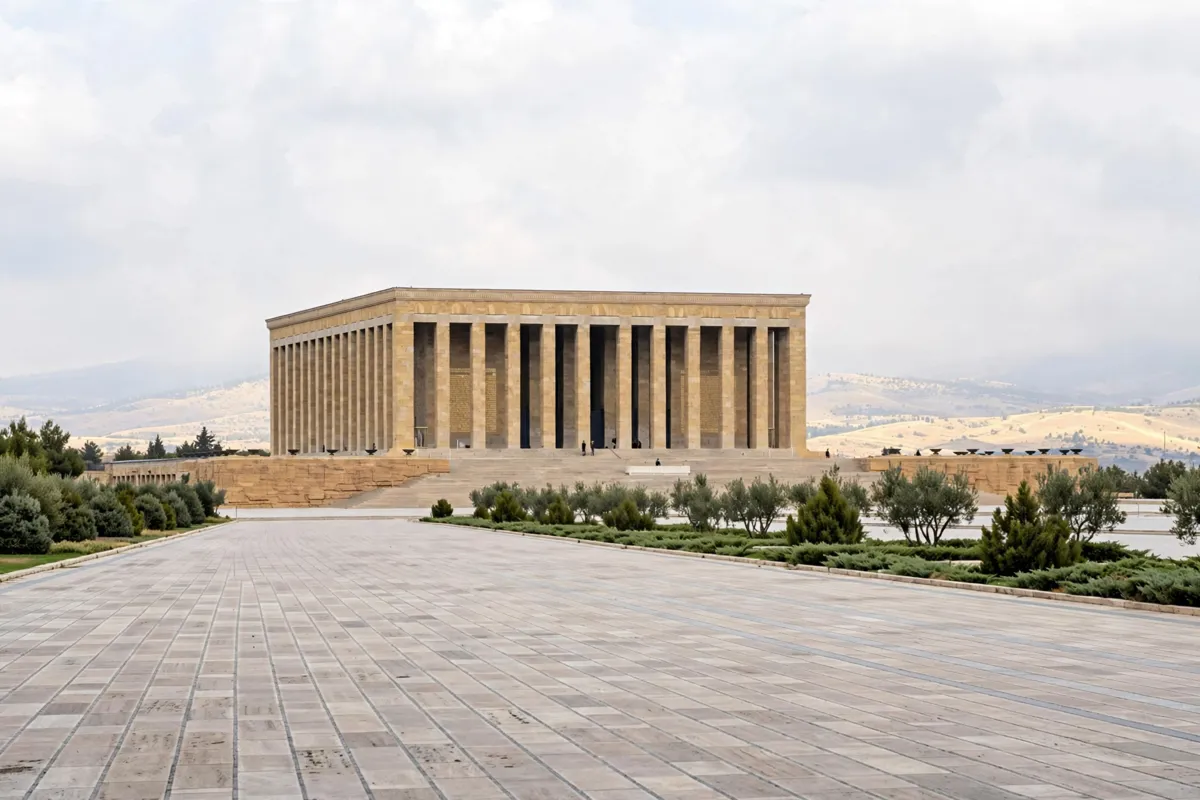
What to see at the mausoleum and museum
The Monument Block brings together the Lion Road, Ceremony Area and Mausoleum. The Lion Road runs for 262 meters and is lined with 24 seated lion statues in Hittite style.
At its end, the Ceremony Area measures 129 by 84.25 meters, with a stated capacity of 15,000 people. Ten symmetrically arranged turrets take their names from concepts associated with the nation’s founding and government.
The mausoleum is reached by a 42-step stairway. In the Hall of Honour, Atatürk’s symbolic sarcophagus is a single piece of red marble weighing 40 tons; his grave lies below the mausoleum’s ground floor.
The Atatürk Museum opened on June 21, 1960. Its displays include personal belongings, gifts, clothes, medals and insignia. The art gallery also includes Atatürk’s personal library and paintings, plus a cinema showing documentary films about Atatürk, the National Struggle and Anıtkabir.
The Peace Park offers a different view of the site, with approximately 48,500 trees and plants representing 104 species. If you enter through Tandoğan Gate, the route through the park leads to a 26-step staircase before the Lion Road.
Getting to Anıtkabir from central Ankara
Anıtkabir’s official address is Anıt Caddesi, Tandoğan, Ankara. Ankara city centre is about an eight-minute walk from Raymar Hotels Ankara, which can serve as a base for planning time in the city. That hotel-to-centre walk does not establish the route or travel time from the hotel to Anıtkabir, so check your chosen transport and directions separately.
For broader route-planning ideas, see this practical one-day Ankara itinerary. The mausoleum is also one of the city’s significant historic places to visit around Ulus; the linked guide can help you plan that separate area of the city.
Opening information and visitor access
Anıtkabir publishes seasonal opening hours. It is open daily from 09:00 to 16:30 from February 1 to May 14, from 09:00 to 17:00 from May 15 to October 31, and from 09:00 to 16:00 from November 1 to January 31.
Separate visitor-hour notices may apply on commemorations and national holidays, including November 10, October 29, September 19, August 30, May 19, April 23 and March 18. Ticket, registration, identification and general grounds-access requirements are not established in the available visitor information.
The official English services page links to guiding services and an accessibility section called “Anıtkabir Without Hindrance,” but detailed facilities and requirements are not specified there. For current hours and access details, check the official site before you go.
Allowing time for the visit
The available information does not give a recommended visit duration, so plan around the parts you want to see rather than relying on a fixed timetable.
The site’s scale, the approach along the Lion Road and the museum’s separate displays all factor into your schedule. If you want to include both the grounds and museum, leave room for each rather than treating the mausoleum as a single stop.
Keep the stairways in mind when planning your route: the approach from Tandoğan Gate includes a 26-step staircase before the Lion Road, and the mausoleum itself is reached by 42 steps. The official services page links to accessibility information, so check those details in advance if they matter to your visit.
Pairing Anıtkabir with other Ankara sights
Anıtkabir can anchor a day focused on Ankara history. Another possible history stop is the Anadolu Civilizations Museum: a government tourism page identifies it as the place where finds from the Phrygian burial mounds removed from Anıttepe are exhibited. The available information does not establish the travel time between the sites, so plan the connection separately.
If you want to add time in the city’s older districts, use the Ankara Old Town guide to consider historic places in Ulus. For a broader schedule that combines city stops, the one-day Ankara guide offers a starting point. Check opening details for each place independently before arranging your day.